
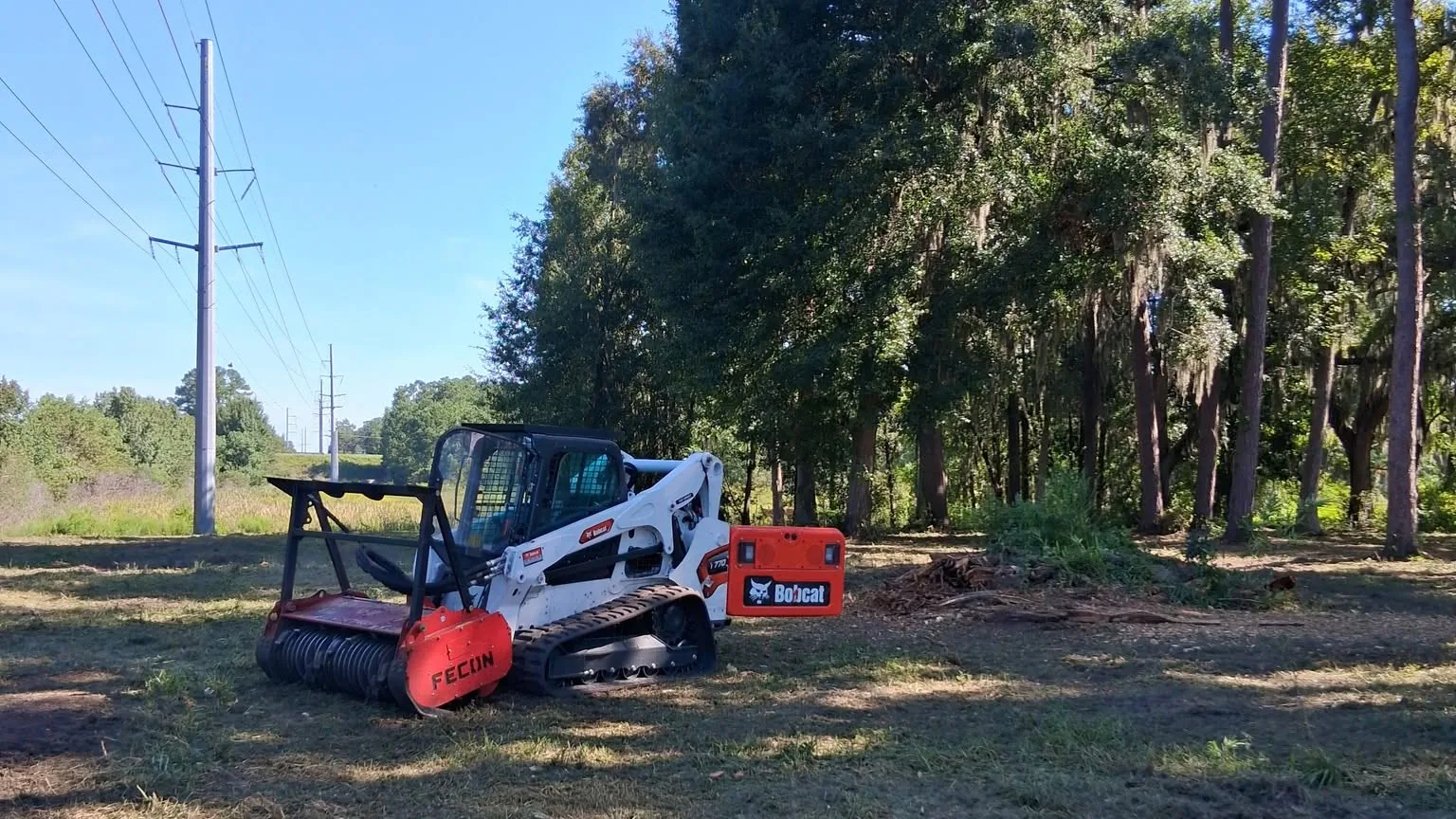
Land clearing starts with a decision about what should stay, not just what should come down. Walk the property, mark the work area and trees to keep, and tell the contractor what you plan to do next. A home pad, a hunting tract, and an access lane need different clearing limits and different finish conditions.
D Brown Off the Chain Lawn Care LLC works on wooded and overgrown land around Hinesville and Southeast Georgia. Derrick Brown walks a tract before running the machine. This guide helps you prepare for that walk and understand where clearing ends and the next contractor's work begins.
1. Start with the next use of the land
A cleared site is not one standard result. The useful result depends on what you need to do after the vegetation is cut. Write down your goal before asking for an estimate, and bring a survey or site plan if you have one.
A homesite needs a defined footprint
Mark the house or building area, driveway, and likely utility route. Tell the clearing contractor which trees provide shade or privacy and should stay. You may need access for a surveyor or builder, but that does not mean every tree on the parcel has to go.
D Brown's land clearing for construction work can open the footprint and access while leaving the rest wooded. The page makes a key boundary clear: Derrick clears vegetation and grinds stumps low; grading, fill, and pad work belong to a grading contractor.
A wooded tract may need selective clearing
If the goal is to walk the woods, improve sight lines, or reach a fence, ask what can be opened while mature trees remain. Brush and saplings can be cut without turning the whole tract into bare ground. D Brown's underbrush-removal service describes that more selective result.
Pro Tip: Walk the intended clearing edge with the contractor. Mark both the area to open and the trees to save. A map helps, but it cannot show every wet patch, old fence, or hidden object under the brush.
Begin with a simple marked plan, even if it is not a construction drawing. Identify the property entrance, the place a machine can turn, the area that needs to be opened first, and any route another contractor will later need. On a wooded parcel, a narrow access path can make a second walk-through possible before you decide how much more to clear. On a homesite, the access path and building footprint may be separate decisions: the best route for moving clearing equipment is not necessarily the final driveway alignment. Bring that distinction to the site walk rather than treating the first path cut through the trees as permanent.
If you are building, ask the builder or surveyor what information they need before the clearing pass. They may need to confirm a building location, elevation, or driveway connection; a clearing contractor should not be asked to determine those from an informal sketch. If the layout is still changing, discuss a limited first phase that opens enough visibility for planning without cutting the trees that might frame the finished property. Make the phase boundary visible on the ground and ask what a return visit would entail. This can prevent a rushed all-or-nothing decision, but it is not a promise that phased work will cost less overall.
For a recreational tract or a fence-line project, define which parts must be drivable, which only need to be walkable, and which should remain untouched. A person on foot can pass where a truck cannot. A future gate, trail, or fence corner may need a wider turn or a more precise line than the rest of the route. If you cannot yet see the existing ground under the brush, ask the contractor to stop and review the route with you after the first pass rather than guessing what lies ahead. This is especially useful when the planned line approaches a ditch, old structure, or adjoining property.
Put the trees-to-keep decision on the same plan as the trees-to-remove decision. A mature tree may matter for shade or privacy even when smaller growth around it needs to go. Point out any low branches or root zones that equipment should avoid, and tell the crew if a particular fence, shed, or landscape feature must be protected. Do not assume an estimate for “clearing the lot” conveys those exceptions. A photograph from the entrance plus a marked site sketch can help the parties remember the walk, but the written scope should still describe the actual limits.
The first decision, then, is not acreage. It is the next use, the access needed to reach it, and what must remain when the vegetation work is done. Those choices give the contractor something concrete to inspect and give you a basis for evaluating the proposed method. They also make it easier to identify work that belongs to a builder, surveyor, utility contractor, or grading crew rather than silently attaching those expectations to a clearing quote.
2. Know what each clearing method does
The word "clearing" can cover mowing, mulching, tree removal, stump work, or a mix. Ask what equipment and finish fit your growth. The same acreage can call for different work if one parcel is grass and another has mature trees.
Mulching leaves the cut material on site
A mulching head cuts brush, vines, and small trees and grinds them into ground cover. It works well where you want to open an overgrown area but keep much of the canopy. It does not remove every root or leave a level building pad. D Brown's forestry-mulching page explains the method and the kinds of growth it handles.
Did You Know? A mulched tract can look open without being ready for excavation. If your next step involves a foundation or utility trench, ask your builder or site contractor what must be removed or prepared after the vegetation work.
Trees and stumps need separate decisions
Ask which trees will be cut, whether logs stay, and what happens to the stumps. Grinding a stump low is different from digging out its full root system. If your project needs roots removed, say so before accepting a clearing scope; the work may belong to another contractor.
D Brown's stump-grinding page covers its grinding service. Do not assume the term "stump removal" in a bid means excavation or off-site hauling. Get the intended finish in writing.
Pro Tip: Ask the contractor to describe what will be on the ground when the machine leaves: mulch, logs, chips, bare soil, or something else. That answer is more useful than the equipment name alone.
A mower, mulching head, saw, and stump grinder solve different parts of a vegetation problem. If the site is mostly grass and light growth, mowing may improve access or maintenance without addressing woody stems. If brush and small trees are the obstacle, mulching may open a path and leave ground cover behind. Larger trees require a separate conversation about cutting, safe work space, and where the wood goes. None of those methods, by itself, guarantees a foundation-ready surface. Ask for the proposed sequence rather than assuming one machine will perform every part of the job.
The material left behind is a planning decision. Mulch and chips can be an acceptable finish for a walkable wooded tract, but they are not the same as a compacted drive or a graded building pad. Cut logs can be left in a designated place, moved within the property, or handled under a different scope; do not assume hauling is included. If you plan to bring in a grading contractor, ask that contractor which residues or stumps must be removed from the area where soil work will occur. The answer may differ between a driveway, a future utility trench, and the wooded area you intend to keep.
Talk about the height and density of the growth in plain terms, then verify it on site. “Brush” might mean vines and saplings on one tract and a mix of fallen timber and larger trees on another. Old wire, metal, concrete, tires, or other debris under that growth can affect the machine plan. You do not need to identify every hidden object before the walk, but you should tell the contractor what you know and avoid promising that an overgrown area is clean. If the work encounters a surprise, the scope should explain whether the crew stops for a decision or proceeds under a stated contingency.
Ask how the chosen method affects the part of the property you want to retain. Selective understory work may leave the canopy, while a building footprint calls for a different level of opening. A machine that fits an access lane may not be the right fit for a tight area beside a structure or a protected tree. Conversely, a hand-cleared edge and a machine-cleared interior can have different time and cleanup requirements. The site walk is where to ask for a method-by-area recommendation, not where to insist that a technique you saw online be used everywhere.
When comparing proposals, translate equipment names into results: what vegetation is cut, how close to the ground it is treated, what stays on site, and what another trade must do afterward. If a contractor says “stumps handled,” ask whether that means grinding below the surface, full excavation, or simply cutting a tree low. If the estimate says “debris cleanup,” ask whether mulch remains spread in place. These are practical scope questions, not a reason to choose the most aggressive clearing method for every parcel. A well-defined finish protects the areas you want to keep as much as it opens the areas you need.
3. Walk the site for access and hidden hazards
A site walk is a planning step, not a formality. Derrick's published site describes a job where he found a bicycle buried in the brush before it reached the mulcher. That is a concrete reason to inspect an overgrown tract before starting a machine.
Show boundaries and places to protect
Bring any survey, plats, or marked property lines you have. Point out wells, septic areas, fences, ditches, drainage paths, and trees to keep. If a boundary is uncertain, resolve it before work reaches that edge. Do not expect a contractor to settle a property-line dispute from an online map.
The access route matters too. A gate, soft shoulder, or wet low spot can change how equipment enters and moves. Ask where the machine will travel and whether any areas need to stay untouched for later work.
Check utilities and burning plans early
For digging or other ground-disturbing work, use the Georgia 811 process and follow its instructions for utility locate requests. A locate does not replace telling the contractor about private lines, septic components, or other features you know about. Ask the next contractor what marks they need for excavation.
If debris is to be burned rather than mulched or hauled, check current rules first. The Georgia Forestry Commission burn-permit guidance explains when permits apply and how restrictions can change. Do not assume a burn is allowed on a particular day or that it is included in the clearing quote.
Did You Know? A cleared access lane may be enough for a survey or inspection even when the rest of the parcel is still wooded. Define the next person's access needs before paying to open areas you plan to keep natural.
Before the walk, gather what you already have: a survey or plat, a builder's preliminary footprint, gate measurements, photographs taken when the brush was lower, and any notes about buried or abandoned features. None of these substitutes for looking at the ground together. Their value is that they identify questions the crew should not have to answer by guesswork. If an old boundary marker or utility route is uncertain, mark it as uncertain in your notes instead of drawing a confident line through it. Ask the appropriate surveyor or utility owner to resolve it before machines work near that spot.
Walk from the entrance toward the proposed work in the same order a machine would have to reach it. Where can a vehicle park without blocking a road or neighbor? Is there room to enter, turn, and exit? Are there low branches, gates, soft shoulders, culverts, or overhead features along the route? An aerial map can help frame the conversation, but it may not show an old fence or a seasonal low spot. If access crosses another person's land, confirm your right to use it; a quote for clearing your parcel is not permission to cross an adjoining parcel.
Discuss water and soil without pretending a clearing contractor is preparing a drainage design. Identify visible ditches, channels, wet patches, and places where runoff already moves. Say whether the work area needs to remain stable for a later vehicle or construction crew. If the plan involves grading, drainage design, wetland work, or changes to a watercourse, ask the qualified local authority and the appropriate contractor about applicable requirements before starting that part of the project. A clean-looking site immediately after vegetation removal is not evidence that future drainage or erosion has been solved.
Utility planning has two layers. Georgia 811 describes a locate-request process for applicable excavation, but the property owner should also identify any known private service lines or features that a public utility locate may not cover. A septic tank, drain field, irrigation line, well line, or private electric feed can be difficult to spot under vegetation. If you are unsure where one is, say so and have it located by the appropriate party before ground-disturbing work in that area. Keep the locate and the clearing scope aligned; a locate for one proposed work area should not be assumed to cover a later expanded footprint.
Treat disposal and fire as separate scope decisions. Mulching leaves material in place; hauling removes material; burning introduces a different set of safety and regulatory questions. If anyone proposes burning slash, verify the current Georgia Forestry Commission and any applicable local restrictions for the actual day and place, then document who is responsible for permits and supervision. Do not infer permission from a previous job, an old web screenshot, or a dry-looking pile. If burning is not in the agreed scope, ask how the cut material will be handled instead.
Finally, make a stop-and-check rule for surprises. If the crew encounters buried metal, a wire fence, an unknown tank, an unmarked line, or a boundary that looks different on the ground, you want a decision before the machine continues. Agree on who can authorize a change and how it will be documented. This is not an attempt to predict every hazard; it is a simple way to prevent an unseen problem from becoming an undocumented change in scope.
4. Set the scope before comparing an estimate
A useful estimate states what land will be opened, which trees stay, how stumps and debris are handled, and what condition is expected at handoff. Ask what is excluded and what might change the price after the site walk. A vague acreage number does not answer those questions.
Make the finish condition specific
Tell the contractor whether the goal is a walkable tract, a usable path, a mowed field, or a clearing ready for a grading crew. Ask if logs or chips remain. If a builder needs the pad area clear by a date, share the site plan and the sequence with the grading contractor.
A written scope helps both sides compare the result, not just the price. If two estimates describe different finish conditions, ask each company to clarify the difference before choosing a bid.
Plan the handoff after vegetation work
Land clearing does not automatically include grading, a foundation pad, fill, or utility installation. Ask each contractor where their work stops and when the next trade can begin. If the schedule depends on dry ground or access, leave room for that in the plan rather than promising a fixed completion date before the tract is walked.
D Brown's land-clearing service explains its owner-operated process and scope. Use it to discuss your parcel with Derrick, then confirm the specific work for your site.
A practical scope can be read aloud without losing the important details. Name the area or phase, identify any trees and structures to protect, say which vegetation is to be cut or mulched, and state what happens to logs, chips, and stumps. Describe the expected access and the handoff condition. If you want a cleared path but not a finished driveway, use those words. If you want a building footprint opened but not graded, say that. Ask the contractor to write exclusions as plainly as inclusions, especially hauling, root excavation, fill, finish grading, utility work, and permitting if those are not part of the job.
Separate a firm decision from an allowance or an unknown. A site walk may identify visible trees and a likely machine route while leaving hidden debris or subsurface work uncertain. Ask how a new condition will be documented and priced before the work expands. Do not turn a preliminary conversation into an assumption that every hidden object is included. This is particularly important if a builder has a deadline: a change in the clearing scope may affect the grading crew's start, even if the vegetation work itself is progressing.
Ask for a plan that matches the sequence of other trades. A surveyor may need access before final boundary marks are set; the builder may need a footprint after the survey; a grading contractor may need larger stumps and roots addressed in the pad area; a utility installer may need a route that stays open. Get those parties' requirements before the clearing crew leaves, or at least confirm who will inspect the result. A cleared-looking tract is not automatically a passed handoff. Photographing the agreed limits and the completed phase can help the owner and next contractor discuss the same places.
Price comparisons belong after scope comparisons. One bid might include a narrow selective pass and leave mulch in place; another might include tree cutting and hauling. Neither number can be judged fairly until the work and finish conditions are aligned. Ask for clarification of a missing item rather than assuming the cheaper proposal forgot it or the more expensive one covers it. The goal is not a universal price per acre. It is a proposal that lets you understand the work on this property, why the method fits, and what you will need to arrange next.
If the job is phased, write down the trigger for moving from the first area to the second. The first pass might open a sight line so you can revise a route, or it might expose a condition that requires a surveyor or utility specialist. Say who decides the revised limits and whether a new estimate is needed. This keeps a legitimate change from being treated as a mistake by either side. It also avoids marking an unfinished second phase complete just because the first phase looks dramatically different from the original overgrowth.
At the end of the walk, test the scope with three questions. First, can you point to the exact limit of the first pass without relying on “roughly over there”? If not, mark the line or request a revised plan. Second, can you describe the ground when the crew leaves—what remains as mulch, what is cut or hauled, and what happens to each stump? If not, ask for a finish description. Third, does the next person on the job know what they will receive and what they still need to do? If not, bring the builder, surveyor, or grading contractor into the conversation before setting a date.
These questions also help on a property that is not being built on. A landowner clearing for access may decide that a walkable trail is enough, while a future equipment route needs a wider, firmer path that the vegetation crew alone cannot provide. A fence contractor may need a straight, visible line with room to work, not a broad cleared field. The written answer should match the actual next use; a generic promise of “clean clearing” cannot tell the next trade where to start.
5. FAQs about land clearing
Does land clearing include grading?
No, not by default. D Brown clears brush and trees and grinds stumps low, but its published service pages say it does not grade or level land. Ask your grading contractor what finish the pad or driveway needs after clearing.
Is forestry mulching enough for a building site?
It depends on the site plan. Mulching can open brush and small growth, but a builder may need tree, stump, root, and soil work beyond that pass. Show the builder's plan to the clearing contractor before setting the scope.
Should I clear the entire property?
Not necessarily. Many owners need only a footprint, access lane, fence line, or selective understory work. Mark the trees and areas you want to keep, then ask for a scope tied to your intended use.
What should I bring to the site walk?
Bring a survey or plan if you have one, photos of the access, and a list of features to protect. Tell the contractor what you will do with the land after clearing. Flag any known private lines, wells, septic areas, and uncertain boundaries.
A good clearing plan starts on foot
The right result is not simply the largest open area. It is the area you need, with the trees you want saved, a clear debris and stump plan, and a clean handoff to the next contractor. Write down that finish before work starts.
For a property around Hinesville or Southeast Georgia, contact D Brown for a site walk and a free estimate. Share the intended use, access point, and areas to protect so Derrick can discuss the actual clearing scope.
